

Here is a look at the top tech stocks that have suffered the steepest declines in 2026.
The rotation out of growth and into value has hit the biggest players the hardest. While the losses are widespread, the numbers behind the declines are staggering.
Microsoft (MSFT) has been one of the hardest-hit megacap names. Shares have fallen approximately 17% year-to-date, wiping out a staggering $613 billion in market value . The catalyst was a quarterly report that showed Azure cloud growth flatlining at 38%. In a market expecting acceleration, a “good but not perfect” report was enough to trigger a flight to safety .

Amazon (AMZN) followed a similar trajectory. The e-commerce and cloud giant saw its stock tumble more than 13% after announcing that capital expenditures would jump by over 50% in 2026 to roughly $200 billion . Analysts at D.A. Davidson downgraded the stock, citing concerns that Amazon Web Services (AWS) is “scrambling to catch up” in the AI race . The sell-off erased approximately $343 billion from its valuation .
Apple (AAPL) , which has taken a more cautious approach to AI spending, has not been immune to the broader market rot. Despite CEO Tim Cook touting “staggering” iPhone demand, the stock has declined roughly 6.5% in 2026, losing about $256 billion in market cap .

Even the chipmakers, once the darlings of the AI boom, are feeling the heat. Nvidia (NVDA) , the bellwether of the semiconductor industry, has seen its market value dip by roughly $90 billion amid concerns that the hardware spending spree may be peaking . Alphabet (GOOGL) , despite beating earnings estimates, guided for a massive $175 billion to $185 billion in capital expenditures, disappointing investors and erasing $88 billion in value .
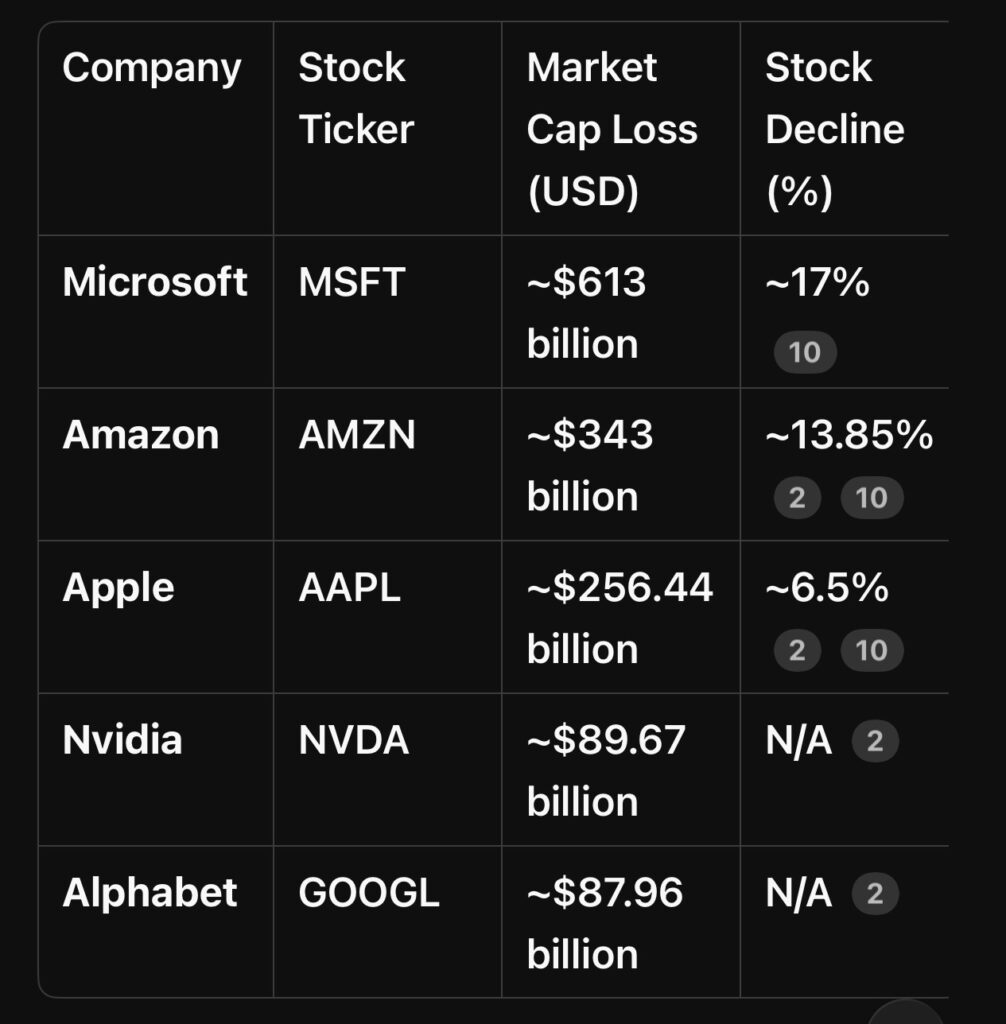
Here is the breakdown of the market cap losses for the “Magnificent Seven” stocks so far in 2026:
Company Stock Ticker Market Cap Loss (USD) Stock Decline (%)
Microsoft MSFT ~$613 billion ~17%
Amazon AMZN ~$343 billion ~13.85%
Apple AAPL ~$256.44 billion ~6.5%
Nvidia NVDA ~$89.67 billion N/A
Alphabet GOOGL ~$87.96 billion N/A
Data reflects losses since Jan. 1, 2026, as reported in mid-February 2026.

The Software Apocalypse
While the megacaps are down, the enterprise software sector is in a full-blown crisis. The fear gripping the market is simple: what if AI agents replace the need for expensive software subscriptions altogether?
The panic was triggered in mid-February when Anthropic launched AI automation plugins for its “Claude Cowork” platform, capable of automating legal contract review and compliance . The market interpreted this as an existential threat to the Software-as-a-Service (SaaS) model.
The numbers are jarring. According to JPMorgan, roughly $2 trillion was wiped off software market caps in a matter of weeks . The Goldman Sachs software basket is down 19% for the year, its worst stretch since 2008 .

ServiceNow (NOW) and Intuit (INTU) are down roughly 25% year-to-date, making them two of the biggest losers in the S&P 500 . Adobe (ADBE) , the owner of Photoshop, has seen its stock drop 20% , leading some analysts to call it the “canary in the coal mine” for the sector . Salesforce (CRM) and Oracle (ORCL) have also suffered double-digit percentage declines .
SAP (SAP) , the European software giant, plummeted 16% in a single day after reporting a weaker-than-expected cloud order backlog .
The Big Picture: A Trillion-Dollar Reckoning
The scale of the sell-off is difficult to overstate. By mid-February, Big Tech firms—including Amazon, Nvidia, Apple, Microsoft, and Alphabet—had lost a combined $1.3 trillion in market value since the start of the year . This figure swells when including the broader software sector, which has seen total losses approach the $2 trillion mark from their recent highs .

Investor sentiment has shifted from speculation to scrutiny. As Deutsche Bank strategist Jim Reid noted, markets were “implicitly pricing in a world where almost every tech company would come out a winner” . The reality of 2026 is that investors are now forcing a differentiation between companies that can monetize AI and those that will be disrupted by it. The “Great Decoupling” is here, and for now, the code-writers are losing to the chipmakers .