
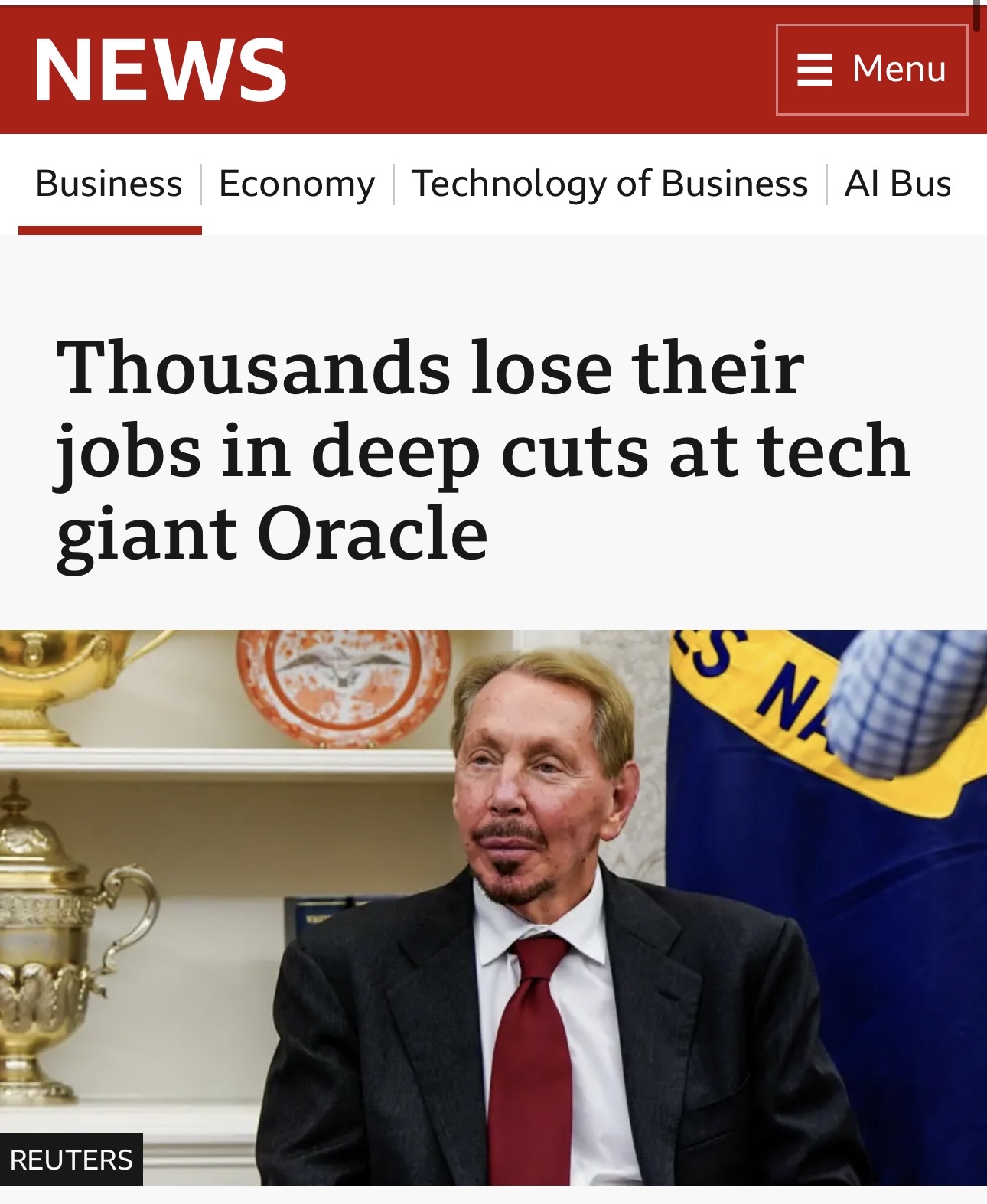
On March 31, 2026, thousands of Oracle employees across the United States and India woke to a cold email. The subject line was mundane, but the message was devastating: “After a careful review of Oracle’s current business needs, we have decided to eliminate your position. This is your last day of employment.”
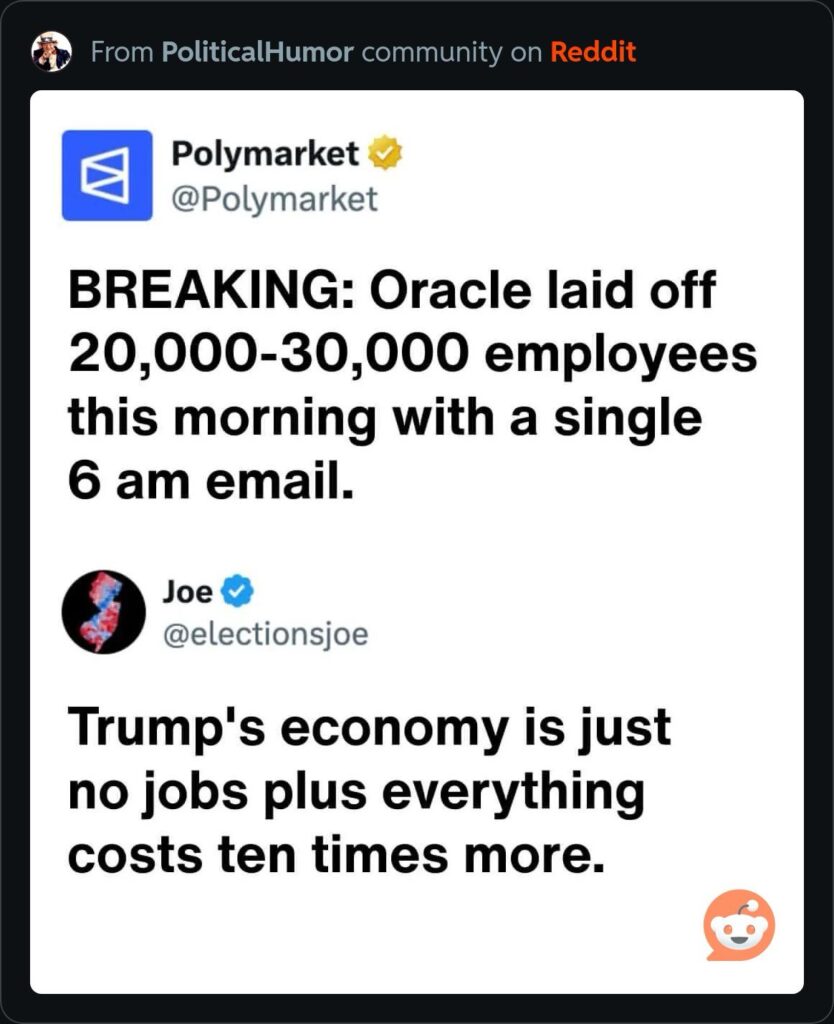
For many, it felt like an April Fool’s prank. It wasn’t. One employee, a developer with five years at the company, told Mint that they only realized the severity when their corporate login failed minutes later .
The cuts, which analysts predict could scale to 30,000 workers—roughly 19% of the global workforce—represent more than just a corporate restructuring . They are the visible fallout of a massive bet on artificial intelligence that has left Wall Street skeptical, the company drowning in debt, and the founder, Larry Ellison, pursuing a controversial consolidation of power that spans Big Tech, Hollywood, and geopolitical influence.

The Cost of the AI Land Grab
To understand the layoffs, one must first understand the scale of the gamble. Over the past two years, Oracle has embarked on one of the most aggressive spending sprees in tech history. Unlike its more cautious rivals in the “Magnificent Seven”—Microsoft, Amazon, and Google—Oracle has prioritized speed over financial prudence.
Under the direction of Larry Ellison, who still owns roughly 40% of the company, Oracle has poured tens of billions into building out AI data centers. In the first nine months of fiscal 2026 alone, the company spent $39.2 billion in capital expenditures—a figure that exceeds its operating cash flow . To fund this, Oracle has gone on a debt-fueled bender, raising $30 billion in a single month earlier this year and pushing total liabilities past $134 billion .

The centerpiece of this strategy is a massive partnership with OpenAI—a deal to supply $300 billion in computing power over five years . It also includes the high-profile “Stargate” project. But these initiatives require infrastructure that doesn’t exist yet, and the market has punished the company for the financial strain.
Oracle’s stock has fallen nearly 50% over the past six months . While the company reported a staggering $553 billion in contracted future revenue—a backlog that dwarfs its current market capitalization—investors remain fixated on the negative free cash flow and the sheer weight of the debt .

The layoffs, projected to generate up to $10 billion in additional free cash flow, are the mechanism by which Ellison plans to pay for his AI empire . Employees in sales, human resources, and even the vaunted engineering teams are being sacrificed to feed the machine.
“AI Did It”—The New Excuse for Old Austerity
Oracle’s official line, echoed across Silicon Valley, is that the cuts are necessary because AI is fundamentally changing software development. “AI is making software engineers the first group to be impacted,” futurist Kevin Kelly recently noted, pointing to a shift from “people writing code” to “people telling AI to write code” .

Executives at Oracle have reportedly told remaining staff that AI coding tools allow smaller engineering teams to move faster . In India, where 12,000 to 15,000 of the layoffs are expected, some senior developers who spent years reskilling found themselves obsolete regardless . One Bengaluru-based developer with 16 years of experience told reporters that despite continuous learning, “my role itself was deemed unnecessary” .
Yet, a closer look suggests that AI is being used as a convenient justification for a broader financial reality. Oracle is not just laying off people because of automation; it is laying them off because it has no cash left. The company is paying a sizable dividend while deeply in the red, and the only way to balance the books without spooking shareholders further is to cut headcount .
As one executive retained in India put it, their survival depended on presenting a “two-year AI adoption roadmap” that promised a 30% headcount reduction each year—a target that turns a technological revolution into a spreadsheet exercise in attrition .

The Ellison Empire: From Data Centers to Propaganda
While the layoffs represent the “cost-cutting” side of Larry Ellison’s strategy, his personal activities reveal a more ideological ambition that has alarmed media watchdogs and pro-Palestinian advocacy groups alike.
In recent years, the Ellison family has transformed from tech investors into media moguls with a distinct geopolitical bent. Alongside his son David, Larry Ellison has assembled a media empire that now includes Paramount Global (owner of CBS) and, after a controversial acquisition, control over TikTok’s U.S. operations . Reports also indicate a looming bid for Warner Bros. Discovery, which would give the family control over CNN, HBO, and a major Hollywood studio .
Critics argue this is not merely business—it is the construction of “narrative infrastructure.” A recent analysis in Al-Quds described the acquisitions as a coordinated effort to reshape the information environment, particularly regarding coverage of Israel .

Larry Ellison’s ties to Israel are deep and well-documented. He is a close friend of Prime Minister Benjamin Netanyahu—having reportedly offered him a job at Oracle and hosted Netanyahu’s family on his private island . He is also one of the largest private donors to the Israeli military .
Following the Ellison family’s takeover of TikTok, observers noted the immediate silencing of prominent pro-Palestinian voices on the platform—a platform Netanyahu had previously described as Israel’s “most important weapon” . In February, protesters in France made their feelings known by draping a banner over Ellison’s $160 million superyacht, renaming it “The Trump Propagandist” in reference to Ellison’s support for Donald Trump and his alleged efforts to purge news networks of coverage critical of Israel and the Trump administration .
Defense Secretary Pete Hegseth has reportedly praised the Ellisons’ pending takeover of CNN, suggesting that the network’s coverage would finally align with the administration’s views on foreign policy .
A House Divided
Oracle finds itself at a peculiar crossroads. On one side, the company is trying to sell itself as the “Dark Horse” of the AI revolution—an infrastructure giant with a half-trillion-dollar backlog and the potential to rival Amazon and Microsoft . On the other, it is bleeding talent, slashing its workforce, and seeing its founder pour his fortune into controlling what Americans see, hear, and believe.
For the 30,000 workers facing termination, the abstract battle over AI and geopolitical narratives is irrelevant. For them, the story is simple: they received an email at 6:00 AM telling them they were expendable.

As one laid-off Oracle employee told the Mint: “I kept reskilling, but I guess that wasn’t enough” . In the end, it wasn’t about skills. It was about a company—and a founder—deciding that the future required fewer people and more power.
The email Oracle sent to its departing staff concluded with a sterile thank you. It read: “We wish you the best in your future endeavors.” For the man who owns the superyacht, the media empire, and the AI infrastructure, the future appears secure. For the thousands now looking for work, it looks terrifyingly uncertain .