
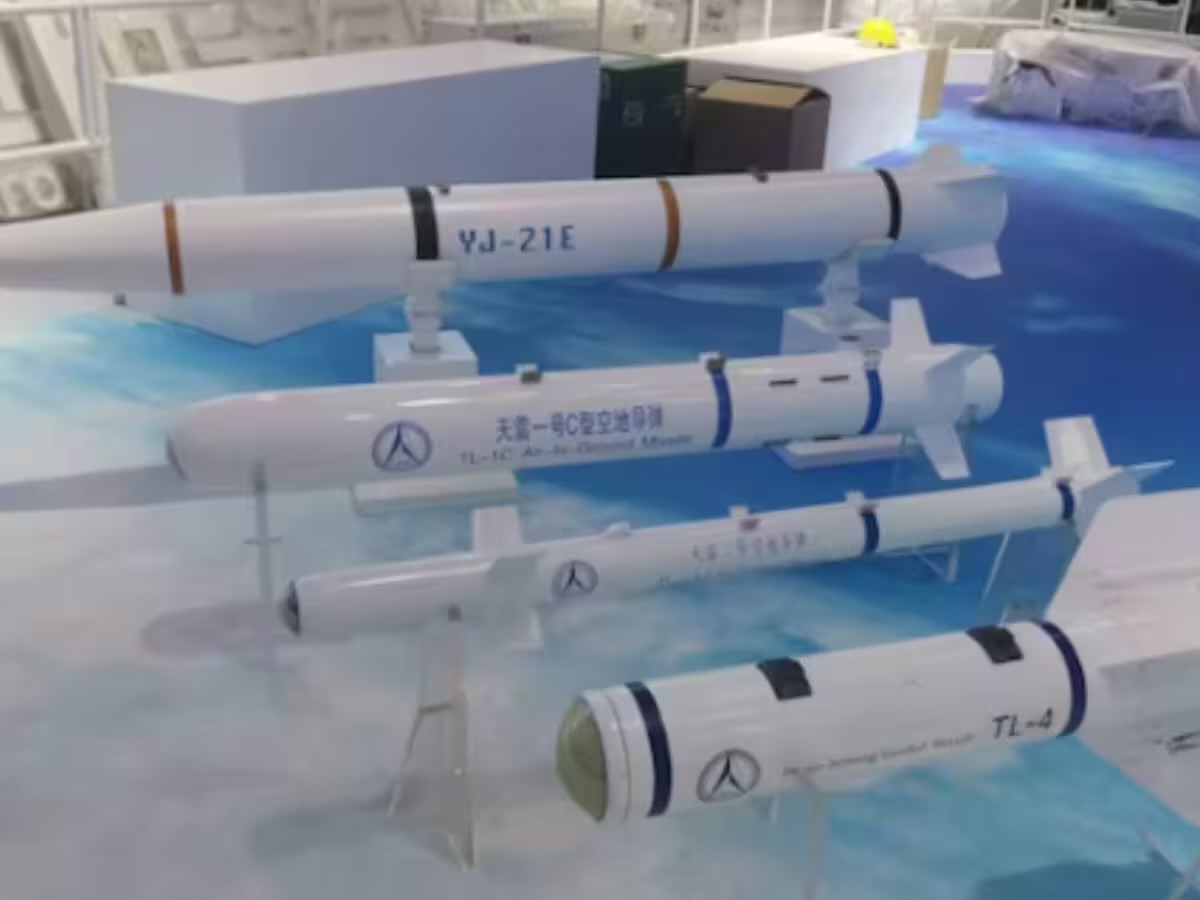
The rise of hypersonic anti-ship ballistic missiles (ASBMs) like China’s YJ-21 is reshaping global military calculations, and nowhere is this more acutely felt than in the Persian Gulf. If Iran ever acquires a weapon with capabilities similar to the YJ-21—a missile designed specifically to sink aircraft carriers—it could fundamentally alter the balance of naval power in the region, potentially rendering the massive, billion-dollar US carrier strike groups obsolete in that key waterway.

🔍 How the YJ-21 Is Reshaping Naval Strategy
The YJ-21 “Eagle Strike” is a ship-launched and air-launched hypersonic anti-ship ballistic missile. Its key features make it a potent “carrier killer”:
· Extreme Speed: A hypersonic missile designed for extreme velocity, with a terminal speed reportedly reaching Mach 10, slamming into a target with immense kinetic energy.
· Long Range and Flight Profile: The ability to strike targets at distances of up to 1,500 kilometers. It uses a two-stage solid rocket motor to boost a hypersonic glide vehicle into the upper atmosphere before it dives toward its target at extreme speed.
· Electronic Warfare: Its terminal-phase speed dramatically reduces reaction time for existing defense systems.

The YJ-21 fits perfectly into a broader “anti-access/area denial” (A2/AD) strategy—designed to create a “no-go zone” for an adversary’s naval forces. By threatening the carrier at stand-off ranges, the YJ-21 forces the carrier to operate much farther from shore, significantly reducing the combat radius of its embarked aircraft and diminishing its offensive power.
🚀 Potential Scenario: Iran and the “Carrier Killer” Export
Currently, Tehran fields its own growing arsenal of anti-ship missiles, with the key Khalij Fars (range ~300km, Mach 3-4) and the longer-range Abu Mahdi cruise missile (range >1,000km). However, these weapons are not hypersonic and present a manageable challenge to layered US Navy defenses compared to the YJ-21’s Mach 10 capability.

The game-changing scenario begins with the YJ-21E, the missile’s official export variant marketed at defense exhibitions. While publicly limited to a range of 290km for export control compliance, actual performance could differ. There are established precedents for China transferring significant missile technology to Gulf nations, such as the sale of DF-3 and DF-21 missiles to Saudi Arabia in the 1980s.

Furthermore, there is significant evidence of deepening military and technological ties between Tehran and Beijing. US intelligence consistently reports on China’s long-standing support for Iran’s missile program and ongoing military cooperation. The potential transfer of a YJ-21-like capability would bridge the technology gap between Iran’s current anti-ship missiles and a true hypersonic “carrier killer.”

🌊 The Impact on US Naval Power: Playing the “Away Game” Forever
The introduction of a YJ-21-like missile into Iran’s arsenal would have a dramatic and multifaceted impact on US naval operations in the Gulf.
· Fleet Displacement: Most critically, the massive range of a hypersonic missile would likely push US carrier strike groups out of the Persian Gulf altogether. The US military has already acknowledged this strategic imperative, conducting exercises to operate carriers from “beyond the horizon” to keep them out of range of Iranian shore-based missiles.

· Calculated Risk: The presence of such a weapon would fundamentally alter the risk calculus for a US president or admiral. Sending a carrier and its 5,000 sailors into a confined waterway like the Persian Gulf, where it would be within easy range of dozens of hypersonic missiles, might become an unacceptable political and military gamble.
· Force Structure Overhaul: The US Navy would be forced to rely more heavily on submarines (which are stealthier but cannot project air power) and surface ships armed with long-range cruise missiles, drastically shifting its operational posture from power projection to fleet survival.

· Saturation Attack Strategy: In the geographically constrained Persian Gulf—just 35 to 60 kilometers wide at its narrowest point—the US Navy’s defensive reaction time is already measured in minutes. A saturation attack, combining a swarm of hundreds of existing cruise missiles with a hypersonic weapon that defeats traditional defenses, could overwhelm even the most advanced Aegis combat system.
⚔️ The Vulnerability of the Carrier: A Debate Intensified

For decades, the aircraft carrier has been the ultimate symbol of naval power projection. However, the YJ-21 and its potential proliferation have intensified the long-running debate over the carrier’s obsolescence.
Defenders argue that carriers remain unrivaled in their ability to project power globally and that their multi-layered defenses, including Aegis cruisers and the Standard Missile-6 (SM-6), have proven effective against existing ASBM threats.
Skeptics, however, contend that the cost and vulnerability of supercarriers are becoming untenable. They posit that the era of the carrier as the queen of the seas is ending, and that navies must adapt to a world where anti-access weaponry holds the upper hand.

💎 Summary
The YJ-21 is not just another missile; it is a technological leap that challenges the most fundamental assumptions of modern naval warfare. For the US Navy, whose global strategy is built around the supremacy of its carrier strike groups, the missile’s proliferation is a primary strategic concern. For Iran, acquiring a weapon of similar capability would be the ultimate asymmetric equalizer—a sword of Damocles capable of keeping the American fleet at bay. In the narrow waters of the Persian Gulf, the debate over the carrier’s obsolescence is no longer an academic theory; it is the central strategic reality of the 21st-century naval competition.
If you’d like to explore a specific aspect, such as the technical details of the YJ-21, the intricacies of US missile defense, or the geopolitics of the region, feel free to ask.