

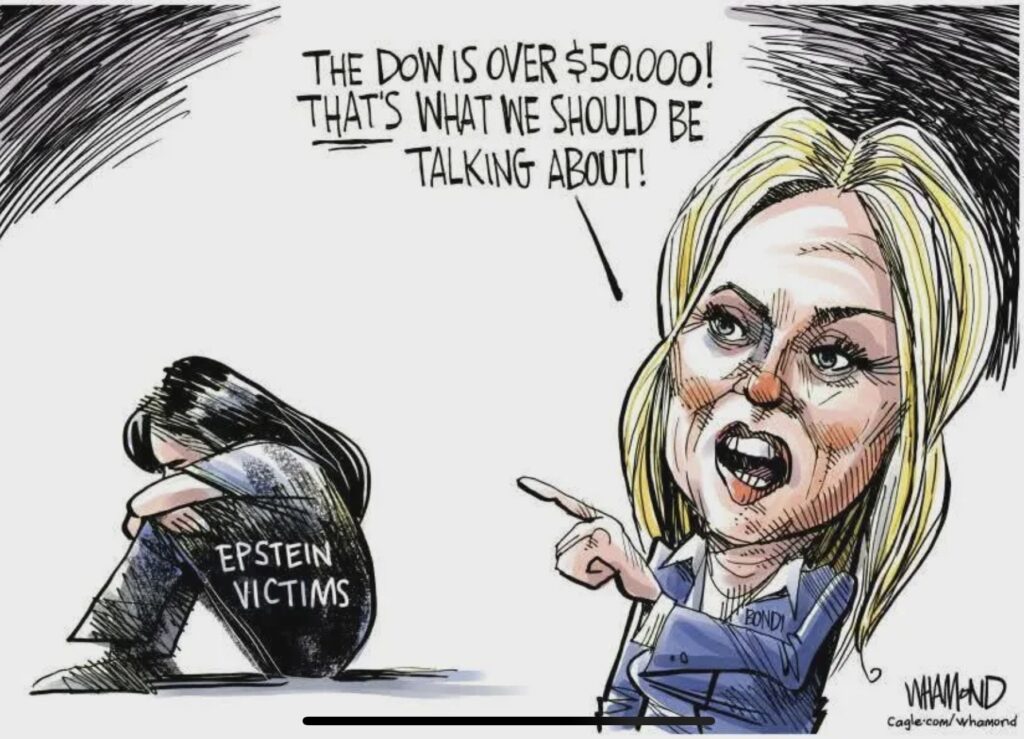
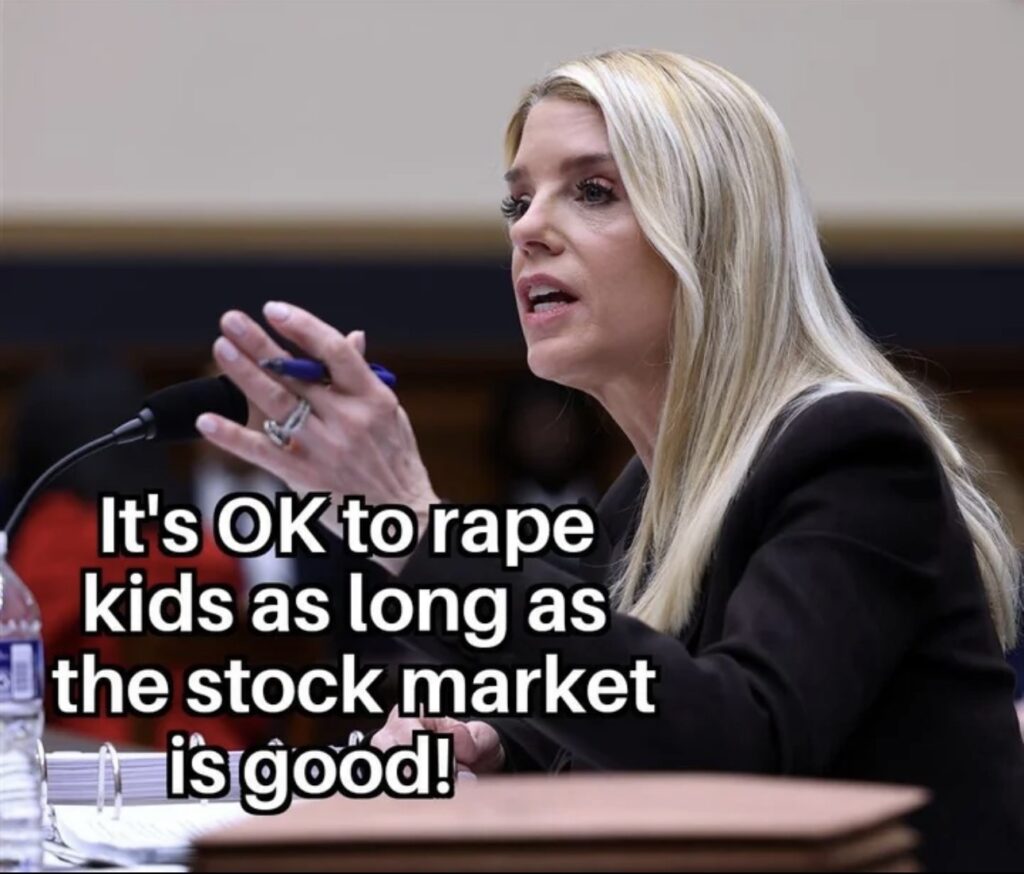
WASHINGTON — At perhaps the most consequential moment of her tenure, Attorney General Pam Bondi stood before the House Judiciary Committee and was asked a direct question: How many of Jeffrey Epstein’s co-conspirators have you indicted? Her answer, shouted over a Democratic lawmaker, had nothing to do with sex trafficking. “The DOW is over 50,000 dollars!” she exclaimed. “The S&P at almost 7,000, and the Nasdaq smashing records” .

It was a pivot so abrupt, so seemingly detached from the subject at hand, that it instantly became an internet meme . But beneath the bizarre optics of an Attorney General citing 401(k)s to deflect questions about a dead pedophile’s network lies a calculated—and politically revealing—dynamic. Bondi’s testimony laid bare a transactional reality of the second Trump administration: the Epstein scandal is not being treated as a criminal justice matter, but as a political communication crisis. The victims are not constituents to be served; they are interruptions to a brand narrative of economic triumph.

“Are You Kidding?”: The Dow as a Shield
The exchange that defined the hearing occurred when Rep. Jerry Nadler pressed Bondi on the number of Epstein associates facing prosecution. When Bondi evaded, Nadler persisted. Bondi’s fuse ignited. “I am going to answer the question the way I want to answer the question!” she snapped .
What followed was not an answer about justice, but a bullet-point recitation of Trump-era economic metrics. When survivors in the audience audibly questioned the relevance, Bondi spun around, incredulous: “What does the Dow have to do with anything? That’s what they just asked. Are you kidding?” .
The moment was jarring precisely because it was so explicitly dismissive. Bondi was not attempting to connect Epstein to the economy; she was openly stating that the economy was the conversation she preferred to have. For a nationwide audience of Trump supporters, this was not a gaffe. It was a signal. The message: Epstein is a Democratic trap; the real story is the “tremendous Republican SUCCESS” Trump is delivering .
The Survivors in the Room
While Bondi shouted about the Nasdaq, eleven survivors of Epstein’s trafficking network sat silently behind her. Rep. Pramila Jayapal asked them to stand and raise their hands if the Department of Justice had never met with them. Every hand went up .
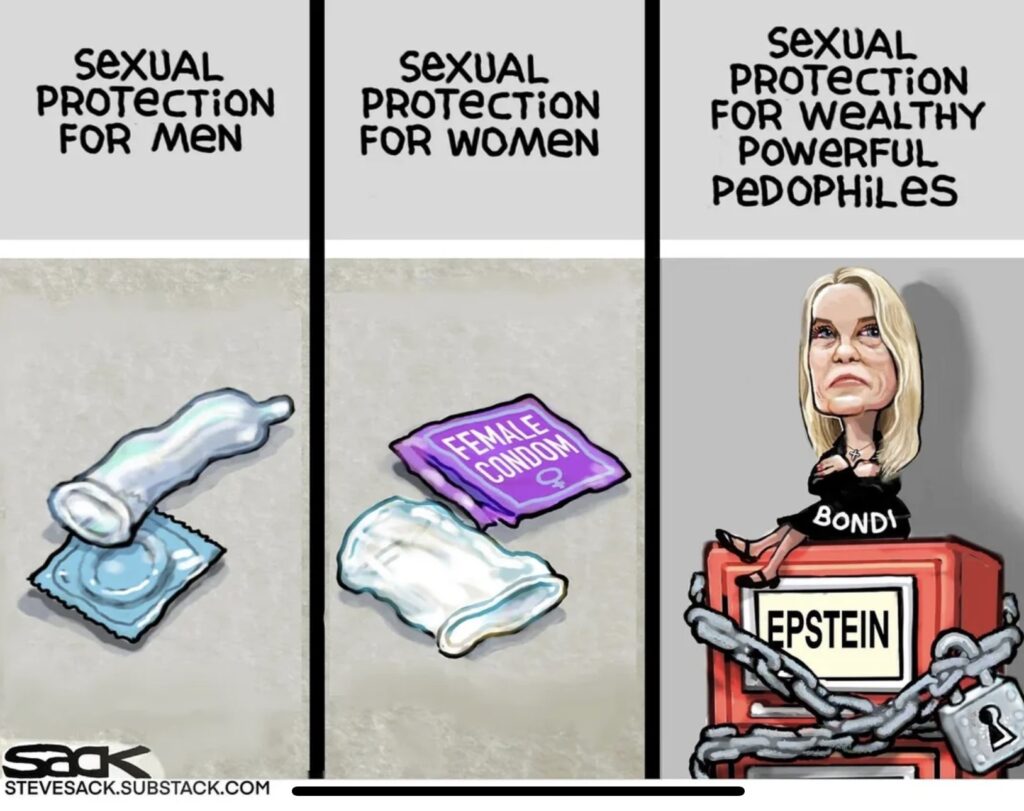
Bondi had opened her testimony by telling survivors she was “deeply sorry” for the abuse they suffered “at the hands of that monster” . But when Jayapal asked her to turn to the survivors and apologize for the DOJ’s own failures—the botched redactions that exposed victims’ names and nude photographs, the release of information that outed decades-old Jane Does to their families—Bondi refused. “I’m not going to get in the gutter for her theatrics,” she sneered .

This was the central contradiction of Bondi’s performance. She expressed sorrow for crimes committed by Epstein, yet dismissed accountability for her own department’s compounding of that trauma as unworthy of “the gutter.” For critics, it crystallized an administration-wide posture: compassion for victims extends only as far as it does not implicate the powerful.
MAGA’s Fracture: The “Fire Her” Contingent
If Bondi calculated that attacking Democrats and touting Trump’s economy would inoculate her with the base, she miscalculated—at least initially. The backlash from the right was swift and savage.

Conservative radio host Erick Erickson declared Bondi “should be fired or resign,” arguing that screaming about the stock market in response to Epstein questions was a dereliction . Kyle Rittenhouse posted that Bondi “needs to resign,” endorsing her subordinate Harmeet Dhillon for the top job . A Turning Point USA contributor labeled her demeanor “disgraceful,” noting “zero excuse” for deflecting on indictments .
Even pro-Trump podcaster Tim Pool, rarely a critic of the administration, lamented that “we are a nation of adult children” and that Bondi’s yelling did not serve the public .
This was not the squishy center revolting. This was the hard-core activist base—the folks who spent years demanding the Epstein “client list”—recognizing that they were being given binders full of public domain documents and told it was transparency. The disconnect between Bondi’s 2025 promise that the files were “sitting on my desk” and her July 2025 declaration that “no further disclosure would be appropriate” had finally curdled into open distrust .

Trump’s Intervention: Exoneration Over Evidence
Then came the lifeline. In a 242-word Truth Social tirade, Trump declared Bondi “fantastic.” He did not defend her handling of the files. He did not address the victims. Instead, he framed the entire hearing through the lens of his own legal jeopardy .
Trump asserted that the Epstein saga had “proven conclusively” that he is “100% exonerated” of “Russia, Russia, Russia type charges.” He accused Rep. Thomas Massie—the Republican who forced the file release—of being a “sanctimonious RINO” making a “total fool of himself” .

Herein lies the key to Bondi’s survival. Her job, as defined by this president, is not to prosecute Epstein’s associates. It is to protect Trump’s political flank. The Epstein files reportedly contain Trump’s name more than a million times in unredacted form . Whether those mentions are incriminating or incidental is almost irrelevant; the sheer volume creates political exposure. Bondi’s role is to ensure that exposure never materializes into accountability.
When Bondi screams about the Dow, she is operationalizing Trump’s strategic doctrine: accuse your accusers, change the subject, and never validate the premise of the question. That she did so while survivors sat feet away, unacknowledged, is not a bug. It is the feature.
The Cover-Up Question
Democrats, and increasingly some Republicans, are using the C-word. Rep. Jamie Raskin told Bondi directly: “You’re running a massive Epstein cover-up right out of the Department of Justice” . Rep. Thomas Massie was blunter: “This is bigger than Watergate. This goes over four administrations… And you are responsible for this portion of it” .

Bondi’s defense—that she released millions of pages—ignores the substance of the criticism. Survivors and journalists have documented sloppy redactions that exposed victims while names of powerful associates remain blacked out. The DOJ has admitted no client list exists, but critics argue the obsession with a “list” was always a straw man; the real scandal is the failure to investigate the enablers still walking free .
What It Means for Trump and MAGA
For Trump, Bondi’s hearing served a dual purpose. Externally, it created a spectacle of Democratic “harassment” that rallies the base. Internally, it tested whether aggressive, Trump-style combativeness can shield an appointee from accountability.
The results are mixed. Trump’s endorsement ensures Bondi keeps her job, but it does not restore trust with the Epstein-obsessed wing of MAGA. Those voters do not want to hear about the Dow; they want scalps. They have watched Bondi go from promising files are “on my desk” to declaring the investigation complete with zero new indictments. Trump’s defense of Bondi is, by extension, a defense of that outcome.
This is the emerging Trump compact: loyalty is rewarded, results are optional. Bondi screamed, insulted a congressman, and changed the subject to 401(k)s. For this, she received presidential praise. The message to every other administration official is unmistakable—your job security depends not on delivering justice, but on delivering defiance.

As for the survivors, they left the hearing with their hands still raised, their meetings still unscheduled, and their questions still unanswered. The Dow, meanwhile, continues to fluctuate.