
“We are now modeling negative free cash flow for ’27 and ’28, which is somewhat shocking to us but likely what we eventually see for all companies in the AI infrastructure arms race.” — Barclays analysts, quoted in a February 2026 tech industry report
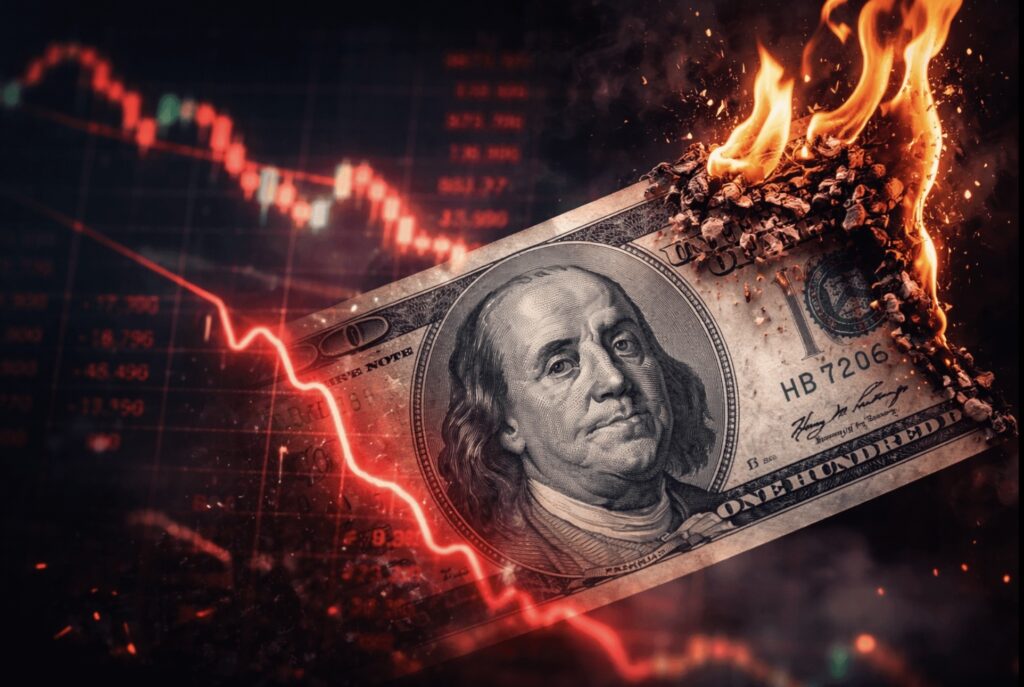
The American artificial intelligence industry, once the darling of Wall Street, is running on financial fumes. Major companies are accumulating staggering debt to fund an insatiable demand for data centers and computing power, triggering warnings of a potential market correction. This brewing financial crisis extends far beyond Silicon Valley, posing a direct threat to the stability of American pension funds and injecting volatility into an already tense 2026 midterm election season.

The Great AI Cash Burn: A Debt-Fueled Gamble
The scale of investment in AI infrastructure has reached historic and arguably unsustainable levels. In 2026 alone, the four “hyperscalers”—Alphabet (Google), Amazon, Microsoft, and Meta—are projected to spend nearly $700 billion on AI infrastructure, a 60% increase from the previous year.
This spending spree is causing corporate cash flows to evaporate. Analysts project that Amazon may see negative free cash flow of $17-$28 billion this year, while Alphabet’s free cash flow could plummet by 90%. Companies are turning aggressively to debt markets to fund this build-out, raising alarms on Wall Street.

High-Risk Exposure: Oracle and CoreWeave
Certain companies exemplify the extreme risk in the sector. Oracle, a legacy tech giant making an all-out AI push, has seen its capital expenditures jump 200% year-over-year. To fund a projected $50 billion in 2026 capex, it raised $18 billion in a single bond sale. The market’s anxiety is palpable: the cost to insure Oracle’s debt against default has tripled and is trading at levels not seen since the global financial crisis.
The situation is even more precarious for cloud service provider CoreWeave. The company carries approximately $15 billion in debt, nearly four times its last twelve months’ revenue. Last quarter, it paid $311 million just in interest—an amount exceeding a fifth of its total revenue and roughly six times its gross profit.

The core vulnerability for these companies is a dependence on a hype cycle that may be slowing. As one analyst noted, investors in 2026 are becoming “less patient with AI spending that doesn’t show results”. The key customer for many, OpenAI, has committed to spending $300 billion with Oracle over five years despite being “deeply unprofitable”. A stumble in demand or a delay in profitable applications could trigger a severe liquidity crisis for the entire ecosystem.
Pension Funds on the Precipice: Concentrated Risk in a Fragile Market
America’s corporate pension system is financially healthier than it has been in decades, with an aggregate funded status estimated at 107% at the end of 2025. However, this strength masks a significant vulnerability: heavy exposure to the U.S. stock market, and by extension, to the technology sector now fueling the AI boom.
The Concentration Problem
· Equity-Heavy Portfolios: Pension funds have benefited from strong equity returns, which boosted their funded status. This success, however, ties their fate closely to the market’s performance.

· Valuation Warnings: Market-wide indicators are flashing caution. The Cyclically Adjusted Price-to-Earnings (CAPE) ratio for the S&P 500 stands near 40, a level last seen during the dot-com bubble and far above its long-term average of 17.33.
· Direct Exposure: While exact allocations vary, major pension funds hold significant positions in big tech stocks. A sharp, AI-driven correction in these names would directly impair pension asset values.

Pension Strategy at a Crossroads
Pension fund managers are aware of these concentration risks. Goldman Sachs analysts have explicitly advised plan sponsors to consider “a diversified asset mix away from concentrated US large cap exposure”. Some funds are increasing hedging strategies and exploring alternative governance models like Outsourced Chief Investment Officers (OCIO).
However, moving a large institutional portfolio is slow. The window to reduce risk may be closing if the AI spending crisis triggers a rapid sell-off. The consequence for retirees could be significant, not in terms of solvency—overfunded plans are secure—but in terms of future benefit improvements, contribution holidays for sponsoring companies, and the overall financial health of the retirement system.
Comparing Key Financial Stress Points
· AI Sector Debt (e.g., CoreWeave): Debt-to-Revenue Ratio ~4x; Interest consumes >20% of revenue
· Big Tech Capex (e.g., Amazon): 2026 projected spend: $200 billion; Projected Free Cash Flow: Negative $17-28B
· U.S. Corporate Pension System: Aggregate Funded Status: ~107%; Key Risk: Concentration in US large-cap equities
· Broad Market Valuation (S&P 500): CAPE Ratio: ~40 (Dot-com bubble level)
The Political Fallout: Economic Anxiety Meets Election Chaos
The intersection of a potential stock market disruption and the November 2026 midterms creates a volatile political scenario. President Donald Trump, who has presided over the AI investment boom, is already expressing anxiety about the elections.
A President Dreading the Midterms
Trump has repeatedly, if “facetiously” according to his staff, mused about canceling the midterm elections. This stems from a clear political reality: “Trump knows that presidents rarely pick up seats in a midterm”. A net loss of just a handful of seats would flip House control to Democrats, empowering them to block his agenda and launch investigations.

The economy is a central pillar of Trump’s political platform. A significant market correction linked to a sector he has often championed could erode his support. Political forecaster Rachel Bitecofer notes a “slump in support among independent voters” and a softening among some Republican cohorts since January 2025. While not a “mass defection,” even modest erosion in a polarized climate can determine control of Congress.
The “Blame Game” Scenario
If an AI-driven market slump occurs in late 2026, the political “blame game” would be immediate and ferocious.
· The Democratic Narrative would likely frame it as the result of reckless corporate speculation and insufficient regulatory oversight, tying Trump directly to Wall Street excess.
· The Trump Administration’s Response would likely blame the Federal Reserve, “overzealous” short-sellers, or previous administrations, while emphasizing long-term economic strength.
This economic uncertainty compounds other administration challenges, such as backlash over immigration policies that have caused “buyer’s remorse” among some Latino voters. The combined effect could amplify the typical “wave” dynamic against the sitting president’s party.

A Perfect Storm in the Making?
We are witnessing the convergence of three powerful forces: unsustainable corporate spending in AI, concentrated pension fund risk, and high-stakes national elections. The trigger would be a loss of investor confidence in the AI profit timeline.
Goldman Sachs analysts posit that the defined benefit system is at a “new tipping point”. That tip could be pushed by a market shock. While pensions are not in imminent danger of collapse, their ability to generate surpluses and provide cost-of-living increases could be set back years.
Politically, the administration is not standing idle. Alongside Trump’s rhetorical attacks on the electoral process, his team is engaged in “gaming the system” through aggressive redistricting, legal challenges to voting rules, and exerting pressure on election administration. An economic downturn would only intensify these efforts, framing the midterms as a necessary bulwark against Democratic policies that would “crash the economy further.”

The ultimate question is one of timing. Will the AI cash burn force a market reckoning before November 2026? If it does, the impact will resonate from the server farms of data centers to the retirement statements of millions of Americans and the ballot boxes in a deeply divided nation. The warning signs are clear; only the magnitude of the consequence remains unknown.