

In what is being hailed by military historians as either the most expensive game of whack-a-mole ever played or a masterclass in creative accounting, President Trump announced this week that the US military has “virtually destroyed Iran.” The only problem? Iran seems to have missed the memo—specifically the part where they were supposed to stop hitting back .

“Iran is a tough country,” Trump told a gathering in Kentucky, presumably while standing in front of a chart showing arrows pointing downward. “But over the past 11 days, our military has virtually destroyed them” .
It was an impressive claim. Almost as impressive as the $800 million in damage Iranian retaliatory strikes have inflicted on US military infrastructure across the Middle East . But who’s counting? Certainly not the folks at the Pentagon, who reportedly briefed Congress that the first six days of “Operation Epic Fury” cost $11.3 billion, with the first 12 days hitting $16.5 billion . That’s what we in the business call “winning at any cost”—literally.

The Art of the (Un)Deal
Let’s break down Trump’s victory lap, shall we? The president assured the American people that Iran’s air force was “gone” in about three hours. “They no longer have radar. They don’t have anti-aircraft equipment. They don’t have anything,” he boasted .
This came as something of a surprise to the US troops stationed at Prince Sultan Air Base in Saudi Arabia, who reportedly watched Iranian drones and missiles hit their radar systems—specifically, components of the THAAD missile defense system that cost approximately $485 million each . One can only imagine the confusion: “Wait, if they don’t have anything, then what just blew up our half-billion-dollar radar?”
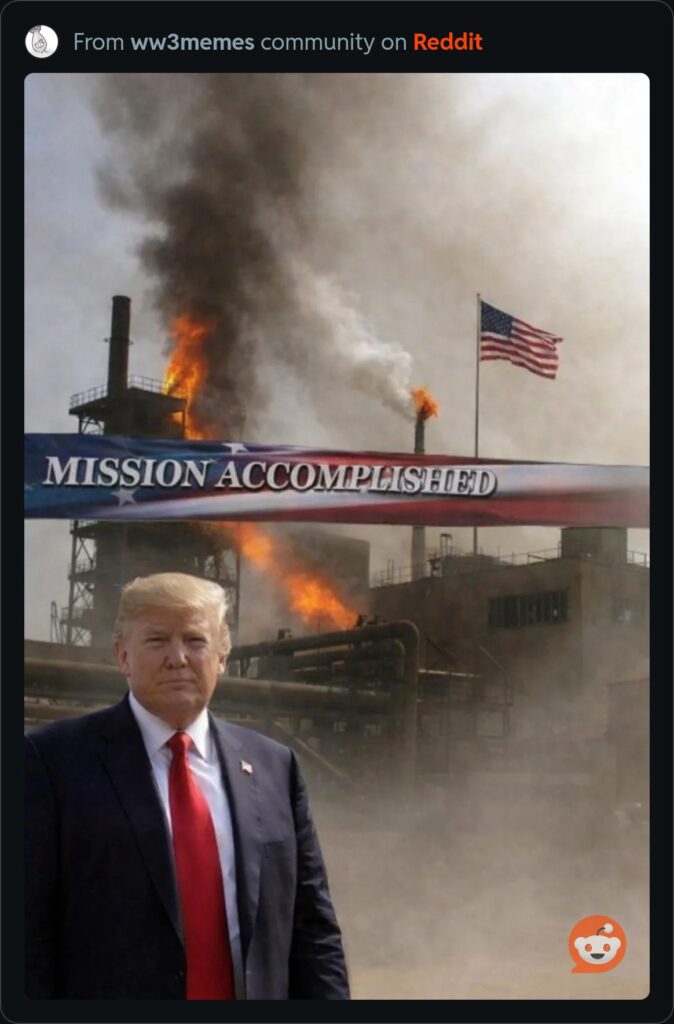
The cognitive dissonance must be especially acute at Al Udeid Air Base in Qatar—the largest US military installation in the Middle East—which has been struck multiple times, along with at least 16 other American sites across the region . Satellite imagery reviewed by the New York Times shows extensive damage to buildings, communication infrastructure, and air defense systems at locations from Kuwait to the United Arab Emirates .

Trump also claimed that US forces had “knocked out 58 naval ships” and “knocked out their navy” . Which raises an interesting question: if Iran’s navy is knocked out, then who exactly keeps hitting US bases? The Iranian Navy’s ghost? Perhaps the same spectral forces that managed to kill seven US service members and wound approximately 140 others during the first ten days of the conflict .
The Economics of “Virtually Destroyed”
Here’s where the math gets truly beautiful. While Trump was announcing that the International Energy Agency would release 400 million barrels of oil to stabilize prices—a move that suggests someone is concerned about, shall we say, market turbulence—the financial reality of his victory was unfolding elsewhere .

According to the Center for Strategic and International Studies (CSIS), Iranian strikes on US bases have caused an estimated $800 million in damage to American military infrastructure . That’s $800 million that Iran spent approximately $0.00 to achieve, given that they were just defending themselves.
But wait, there’s more! The US has also reportedly lost more than a dozen MQ-9 Reaper drones during exchanges with Iran. Each of these drones costs between $30 and $32 million, meaning American taxpayers are now the proud owners of approximately $330 million worth of scattered debris across the Middle East .

Defense Secretary Pete Hegseth, apparently embracing a “more money than sense” approach to military strategy, explained that the Pentagon is asking for another $200 billion in war funding. “It takes money to kill bad guys,” Hegseth said helpfully . Indeed it does. According to the Penn-Wharton Budget Model, the total economic hit from Operation Epic Fury could reach as high as $210 billion when you factor in direct costs and economic disruption .
Let’s put that in perspective: $210 billion is enough to fund the Department of Education for about two years. It’s enough to buy every American a moderately nice pizza. Instead, we’ve purchased a conflict where our $3-4 million Patriot missiles are being used to shoot down Iranian drones that cost between $20,000 and $50,000 . That’s a cost-exchange ratio that would make even the most aggressive used car salesman blush.

As Arthur Erickson, CEO of drone manufacturer Hylio, put it: “It is clearly more expensive to shoot down a drone than to launch one into the sky. This is ultimately a matter of money. Even conservatively estimated, the cost ratio for intercepting a single drone is about 10 to 1” .
The Art of the Backfire
Perhaps the most poetic moment in this symphony of self-inflicted wounds came when Trump explained why the US had to restart military operations. “After Midnight Hammer, we left. We figured that’ll be the end of them for a while. But they started again. That’s why we got to finish it,” he said .
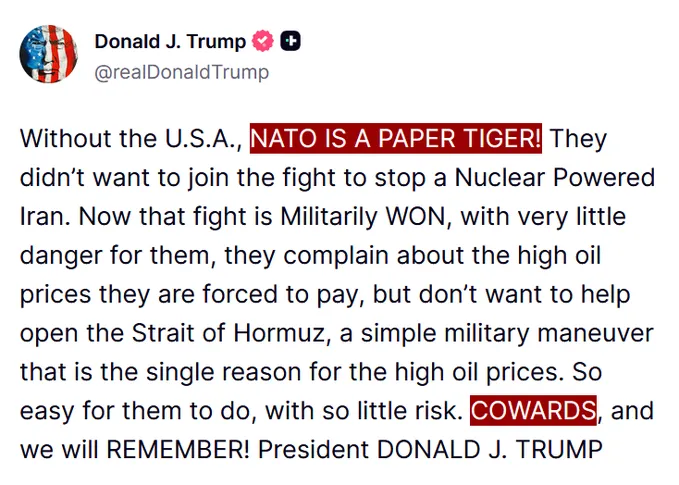
Translation: We attacked them, left, and they had the audacity to still exist. So now we have to attack them harder.
This is the strategic equivalent of punching someone, walking away, and then being shocked—shocked!—when they punch back. Then deciding that the solution is to punch them again, only harder this time, while insisting that you’ve “virtually destroyed” them even as they continue to punch your bases, embassies, and consulates across an entire region.

Speaking of which: Iran hasn’t just limited its attentions to military installations. US diplomatic sites have also been hit, including the Baghdad Diplomatic Support Center (near the airport), where six drones were launched at the compound. Five were intercepted; one hit near a guard tower . The consulate in Dubai, embassies in Kuwait City and Riyadh have also been struck, forcing temporary closures .
Nothing says “we’ve virtually destroyed them” quite like having to close your own embassies because the people you’ve “destroyed” keep attacking them.
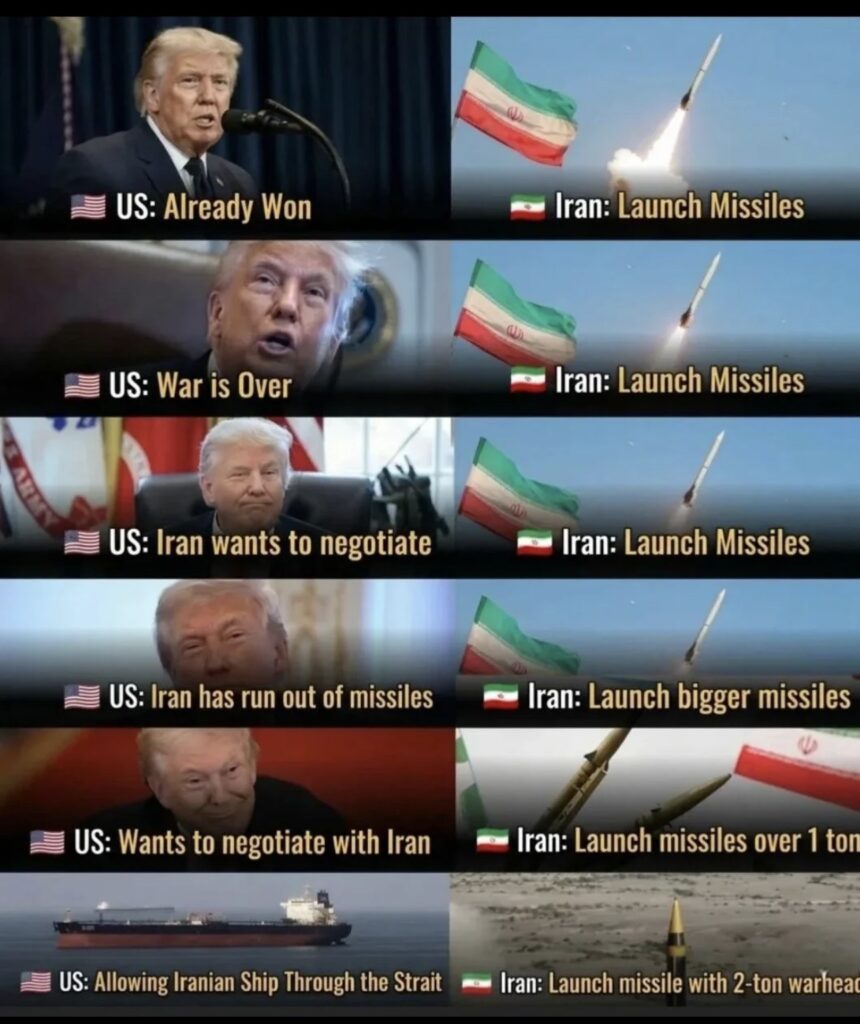
The Grand Finale
As of March 19, 2026, the war has been ongoing for nearly three weeks. Trump has promised that “we don’t want to go back every two years” . Which is reassuring, because at the current rate of spending, we might not be able to afford to.
The administration has asked Congress for another $200 billion. When asked if this number might change, Hegseth replied that it “could move” . One imagines it moving in only one direction: up.

But let’s give credit where it’s due. Trump was absolutely right about one thing: “Nobody has ever seen anything like what you’re witnessing now” . He’s correct. We have never before witnessed a president claim “virtual destruction” of an adversary while simultaneously overseeing the destruction of $800 million worth of American military equipment, the loss of $330 million in drones, seven American service members killed, and $210 billion in potential economic losses.
If this is victory, one shudders to imagine what defeat might look like.

Perhaps the most fitting epitaph for this conflict comes from Admiral Brad Cooper, commander of US Central Command, who noted on March 7 that Iranian ballistic missile attacks had dropped 90 percent since the first day of the conflict, and drone attacks by 83 percent . Some might interpret this as Iran running out of ammunition. Others might note that when you’ve already hit 17 US sites and caused nearly a billion dollars in damage, you don’t necessarily need to keep going.

Either way, Trump remains optimistic. “We’re doing extremely well in Iran,” he assured the American people at a White House event .
Well, Mr. President, at least the oil is flowing. For now.
— Written with the kind of admiration one reserves for a magician who somehow makes his own wallet disappear while claiming to have found gold.