
In the rarefied air of the United States Supreme Court courtroom, where tradition demands decorum and voices rarely rise above a measured tone, Chief Justice John Roberts delivered what should have been a routine announcement. For ten gripping minutes on the morning of February 20, 2026, he methodically laid out the case against President Donald Trump’s signature economic initiative—a sweeping global tariff policy that had yielded billions for the national treasury while roiling world markets and hitting American consumers hard .
The white marble setting provided a study in contrast to what would unfold later that day at the White House. Roberts’ voice was steady, his words measured, as if to minimize this outsize clash between the judiciary and executive branches . He emphasized the limits of the question at hand, citing the revered Chief Justice John Marshall from two centuries earlier, who had deemed the authority to impose tariffs “a branch of the taxing power”—firmly the domain of Congress .
“We claim no special competence in matters of economics or foreign affairs,” Roberts elaborated in his 21-page written opinion. “We claim only, as we must, the limited role assigned to us by Article III of the Constitution. Fulfilling that role, we hold that [the International Emergency Economic Powers Act] does not authorize the President to impose tariffs” .
Hours later, across the city at the White House briefing room, President Trump stood before cameras and delivered a very different kind of address—one that would test the boundaries of presidential rhetoric and the independence of a co-equal branch of government in ways unprecedented in American history .
I. The Decision: A 6-3 Rebuke of Executive Power
The case, Learning Resources v. Trump, represented one of the most significant separation-of-powers disputes to reach the high court in decades. At its core lay a fundamental question: Could a president, acting alone and without congressional approval, impose unlimited tariffs on nearly every country in the world by invoking a 1977 law designed for national emergencies?
The Supreme Court’s answer, delivered in a 6-3 ruling, was a resounding no .
The majority held that the International Emergency Economic Powers Act (IEEPA)—which allows presidents to regulate or block imports during foreign-related national emergencies—does not clearly grant the power to impose tariffs . The Constitution, Roberts emphasized, gives Congress the power to levy taxes and tariffs, and never before had a president invoked IEEPA as grounds for such sweeping trade penalties .
What made the ruling particularly striking was the coalition that formed the majority. It included not only the court’s three liberal justices—Elena Kagan, Sonia Sotomayor, and Ketanji Brown Jackson—but also three conservatives: Chief Justice Roberts (a George W. Bush appointee) and, most significantly, two of Trump’s own nominees from his first term, Neil Gorsuch and Amy Coney Barrett .
The three dissenters—Clarence Thomas, Samuel Alito, and Brett Kavanaugh (another Trump appointee)—argued that the tariffs were “clearly lawful” under the statute .
For Trump, who had enjoyed a remarkable winning streak at the Supreme Court dating back to the 2024 decision granting presidents substantial immunity from criminal prosecution, this represented a rare and deeply personal defeat .

II. The Majority: Six Justices in the Crosshairs
Chief Justice John Roberts: The Institutionalist’s Stand
As the author of the majority opinion and the leader of the court’s conservative wing, Chief Justice Roberts found himself in an unfamiliar position: the primary target of a sitting president’s wrath.
Roberts, now in his 21st year in the center chair, had carefully crafted an opinion designed to minimize the political fallout. He emphasized that the justices had similarly rejected major initiatives of then-President Joe Biden, suggesting that the court was merely fulfilling its constitutional role rather than targeting Trump personally . He invoked the narrowness of the question at hand, saying nothing about the practical implications of refunding the billions already collected .
But Roberts also delivered a subtle dig at the dissenters who had invoked a 1981 case, Dames & Moore v. Regan, to justify expansive presidential authority. Roberts had been a law clerk to then-Justice William Rehnquist when Rehnquist penned that decision, and he knew its limits intimately. Lifting five distinct lines from Rehnquist limiting the reach of Dames & Moore, Roberts added with a trace of levity: “This is not quite ‘no, no, a thousand times no,’ but should have sufficed to dissuade” the dissenters from invoking the case .
Trump’s response was anything but measured. At his White House press conference, the president cast the Roberts Court majority as his nemesis, calling the justices who ruled against him “a disgrace to our nation” .
“I’m ashamed of certain members of the court. Absolutely ashamed for not having the courage to do what’s right for our country,” Trump declared, his anger barely contained .
The president went further, launching an attack not just on the decision but on the institutional integrity of the court itself. “It’s my opinion that the court has been swayed by foreign interests,” Trump asserted, though he provided no details or evidence for the claim. When a reporter pressed him to elaborate, he declined .

For Roberts, who has on rare occasion rebuked Trump—such as when he issued a statement last year after Trump called a federal judge “crooked” and suggested impeachment—this latest barrage drew no immediate response. The chief justice, true to form, maintained his institutional composure, saying nothing later in the day about Trump’s comments .
Justice Neil Gorsuch: The First Betrayal
For Neil Gorsuch, Trump’s first appointment to the Supreme Court, the stakes were particularly high. Nominated in 2017 after the unprecedented blockade of Merrick Garland’s nomination, Gorsuch had been Trump’s opportunity to reshape the judiciary in his first year in office.

Now, nine years later, Gorsuch found himself on the opposite side of a case his appointing president cared about deeply.
Trump did not hide his disappointment. In a series of social media posts and public remarks, the president pointedly criticized the two justices he had nominated who voted against him.
Trump posted on social media, according to Chinese media reports—translated as: “What’s going on with the two Supreme Court justices I nominated, Barrett and Gorsuch, despite tremendous opposition?” .

At the press conference, Trump was even more direct. When asked if he regretted nominating Gorsuch and Barrett, the president stopped short of saying he had made a mistake. But his words carried unmistakable sting.
“It’s an embarrassment to their families, to one another,” Trump said, bringing the justices’ families into his critique in a highly unusual move .
The president described their votes as “terrible” and suggested they had failed in their duty to the nation . In Trump’s framing, Gorsuch and Barrett had joined with “radical left Democrats” to undermine American economic interests .
“They’re just being fools and lapdogs for the Rhinos and the radical left Democrats,” Trump said, using the shorthand for “Republicans in Name Only” deployed by some on the right to disparage fellow Republicans deemed insufficiently loyal .

Justice Amy Coney Barrett: The Conservative Star’s Crossroads
Perhaps no justice faced a more personal cross-examination from the president than Amy Coney Barrett. Appointed in the final weeks of Trump’s first term, after the death of Justice Ruth Bader Ginsburg, Barrett had been hailed as a conservative intellectual force who would solidify the court’s rightward tilt for decades.
Her vote against Trump’s tariffs thus carried particular symbolic weight.
Trump did not spare her. In addition to calling her vote an “embarrassment to her family,” the president suggested that Barrett and Gorsuch had somehow been co-opted by the left .
Trump observed on social media—”Whether people like it or not, this situation never seems to happen to Democrats. Democrats vote against Republicans almost every time, but they never vote against their own, no matter how justified the reason” .

For Barrett, who had carefully cultivated an image of judicial independence and originalist methodology, Trump’s attack represented an uncomfortable political reality: in the eyes of the president who appointed her, loyalty apparently required more than fidelity to the Constitution as she understood it.
Justice Elena Kagan: The Liberal Institutionalist
As one of the court’s three liberal justices, Elena Kagan might have expected to be on the receiving end of presidential criticism. Appointed by Barack Obama in 2010, Kagan had built a reputation as a pragmatist and institutionalist, often seeking common ground with her conservative colleagues.
In joining Roberts’ majority opinion, Kagan was doing what liberal justices typically do: voting to limit executive power when exercised by a Republican president. But Trump’s response made no distinction based on ideology.
“They’re just being fools and lapdogs for the Rhinos and the radical left Democrats,” Trump said, grouping Kagan with the conservative justices who had crossed him .
The president’s broader accusation that the court had been “swayed by foreign interests” implicitly included Kagan, though he offered no specifics .
Justice Sonia Sotomayor: The Dissenter-in-Chief Turned Ally
For Sonia Sotomayor, the court’s most outspoken liberal, joining a majority that limited presidential power was entirely consistent with her judicial philosophy. Appointed by Obama in 2009, Sotomayor had frequently dissented from the court’s conservative rulings, but on this question—the scope of executive authority—she found common ground with Roberts and the other conservatives in the majority.
Trump’s blanket condemnation of the six justices made no exception for Sotomayor’s usual role as a liberal firebrand. In his telling, all six were “unpatriotic and disloyal to our Constitution” .
Justice Ketanji Brown Jackson: The Newest Justice’s First Major Test
As the newest member of the court, appointed by President Joe Biden in 2022, Ketanji Brown Jackson had yet to face the kind of political firestorm that often engulfs the justices. The tariffs case provided an early test.
Jackson joined the liberal wing of the court in voting to strike down Trump’s policy, a decision consistent with her judicial approach. Trump’s response lumped her in with the others he deemed “fools and lapdogs” serving “radical left” interests .
For Jackson, the attack represented an introduction to a new reality: on a court whose decisions increasingly intersect with presidential power, even the newest justice cannot escape the political crossfire.
III. The Dissenters: Three Justices Praised
Justice Brett Kavanaugh: The Swing Vote Who Swung the Other Way
Of all the justices, Brett Kavanaugh received the most effusive praise from President Trump. In a lengthy dissent, Kavanaugh argued that the tariffs were “clearly lawful” as a matter of text, history, and precedent .
But Kavanaugh also highlighted what he saw as the practical consequences of the majority’s decision. The ruling said nothing about whether companies could recover the billions they had already paid in tariffs—a question that importers including the warehouse chain Costco had already raised in court.
“The Court says nothing today about whether, and if so how, the government should go about returning the billions of dollars that it has collected from importers. But that process is likely to be a ‘mess,’ as was acknowledged at oral argument,” Kavanaugh wrote .
Trump seized on Kavanaugh’s warning, praising him repeatedly at the press conference. The president called Kavanaugh a “genius” and said he was “so proud of him” for his dissent .
In Kavanaugh’s courtroom behavior, there was a hint of the political awareness that has characterized his tenure. Unlike some of his colleagues, Kavanaugh chose not to read any excerpt from his dissent aloud when the ruling was announced, simply looking out impassively at the spectators .

Justice Clarence Thomas: The Senior Dissenter
For Clarence Thomas, the court’s senior associate justice and a reliable conservative vote since his appointment by George H.W. Bush in 1991, the tariffs case presented a straightforward question of statutory interpretation.
In his dissent, Thomas wrote that “neither statutory text nor the Constitution provide a basis for ruling against the President” . He added that “the Court has long conveyed to Congress that it may vest the president with large discretion in matters arising out of the execution of statutes relating to trade and commerce with other nations” .

Trump thanked Thomas for his “strength and wisdom and love of our country” .
Justice Samuel Alito: The Consistent Conservative
Samuel Alito, appointed by George W. Bush in 2006, joined Kavanaugh’s dissent without writing separately. His vote to uphold the tariffs was consistent with his general approach of deferring to executive authority in matters of national security and foreign affairs.
Trump included Alito in his thanks to the three dissenters, praising them collectively for their “strength and wisdom” .
IV. The Aftermath: Trump’s Alternative Path and Escalating Rhetoric
The Supreme Court’s ruling might have ended the matter, but President Trump made clear he had no intention of accepting defeat.
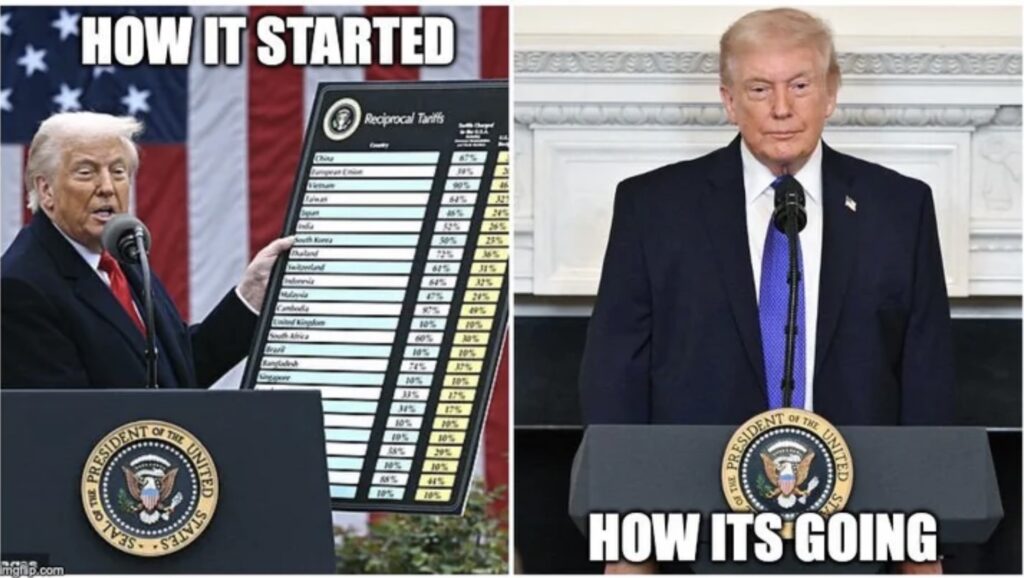
Within hours of the decision, Trump announced that he would sign an executive order imposing a 10% global tariff under Section 122 of federal law—though those tariffs would be limited to 150 days unless extended legislatively .
“The good news is that there are methods, practices, statutes and authorities as recognized by the entire Court in this terrible decision, and also as recognized by Congress, which they refer to, that are even stronger than the IEEPA tariffs available to me as president of the United States,” Trump said .

The president mentioned other legal avenues, including the Trade Expansion Act and the Tariff Act of 1930, acknowledging that those options would involve “a little bit longer process” .
“Their decision is incorrect. But it doesn’t matter because we have very powerful alternatives,” Trump asserted .
As for the billions of dollars already collected under the now-invalidated tariffs—estimates ranged from $175 billion to over $200 billion—Trump was noncommittal about refunds .
“They take months and months to write an opinion, and they don’t even discuss that point,” Trump said. “I guess it has to get litigated for the next two years” .
Trump’s rhetoric escalated further when asked about the upcoming joint session of Congress, which many justices traditionally attend. Trump said he “couldn’t care less” whether the justices showed up, adding that they were “barely” still invited—a statement that ignored the constitutional reality that the president does not control access to the House chamber .

Vice President JD Vance joined the offensive, posting on social media that the Supreme Court was “purely and simply a bunch of outlaws” .
V. Reaction and Analysis: A Constitutional Crossroads
Legal scholars and court watchers expressed alarm at the unprecedented nature of Trump’s attack.
“I think the court was well aware of the importance to the president of this decision,” said Alan Wm Wolff, a former deputy director-general of the World Trade Organization .
Colin Grabow, a trade expert at the Cato Institute, a libertarian think tank in Washington, described the decision as “a victory for the rule of law.”

“It’s unfortunate that he attacked these justices,” Grabow said. “The Supreme Court said [Trump] went too far. President Trump took that as an affront. It’s not a surprise” .
Steve Schwinn, a constitutional law professor at the University of Illinois Chicago, offered a more pointed assessment. Trump’s remarks, he said, were “unprovoked and ad hominem attacks that not only violate norms and decorum, but also reveal a profound misunderstanding of the separation of powers and democratic institutions themselves” .
Even some of Trump’s allies expressed discomfort with the personal nature of the attacks on Gorsuch and Barrett, two conservative justices whom the president had personally elevated to the nation’s highest court.
The practical implications of the ruling extended beyond the constitutional drama. The decision threatened to complicate the US-India interim trade agreement, which had been announced just weeks earlier and was expected to be signed by the end of March . Under that deal, India had agreed to eliminate or reduce tariffs on US industrial and agricultural goods, while the United States would impose a reciprocal tariff of 18% on Indian goods .
With the Supreme Court’s ruling invalidating the legal basis for those reciprocal tariffs, observers noted that the negotiations might need to be revisited .
VI. Conclusion: The Court and the President in a New Era
As the sun set on February 20, 2026, the United States found itself in uncharted constitutional territory. A sitting president had publicly attacked six Supreme Court justices by name, accusing them of being “fools,” “lapdogs,” “unpatriotic,” and “disloyal”—while praising the three who voted in his favor .
The justices themselves offered no response. Chief Justice Roberts, true to his institutionalist instincts, said nothing. The courtroom had been not quite full for the announcement—several seats in the lawyers’ section, press rows, and justices’ guest area were empty, perhaps reflecting weeks of dashed expectations after observers had anticipated a decision in early January .

But the emptiness of those seats belied the fullness of the moment. For the first time in American history, a president had turned a Supreme Court ruling into a spectacle of personal grievance, naming individual justices as objects of public scorn while praising others for their loyalty.
The six justices in the majority—Roberts, Gorsuch, Barrett, Kagan, Sotomayor, and Jackson—now face a new reality. In Trump’s second term, the independence of the judiciary is not merely a constitutional principle to be defended in the abstract; it is a target to be attacked in the most personal terms imaginable.

Whether the court’s institutional legitimacy can withstand such sustained assault from a co-equal branch of government remains an open question—one whose answer will shape American democracy for generations to come.