
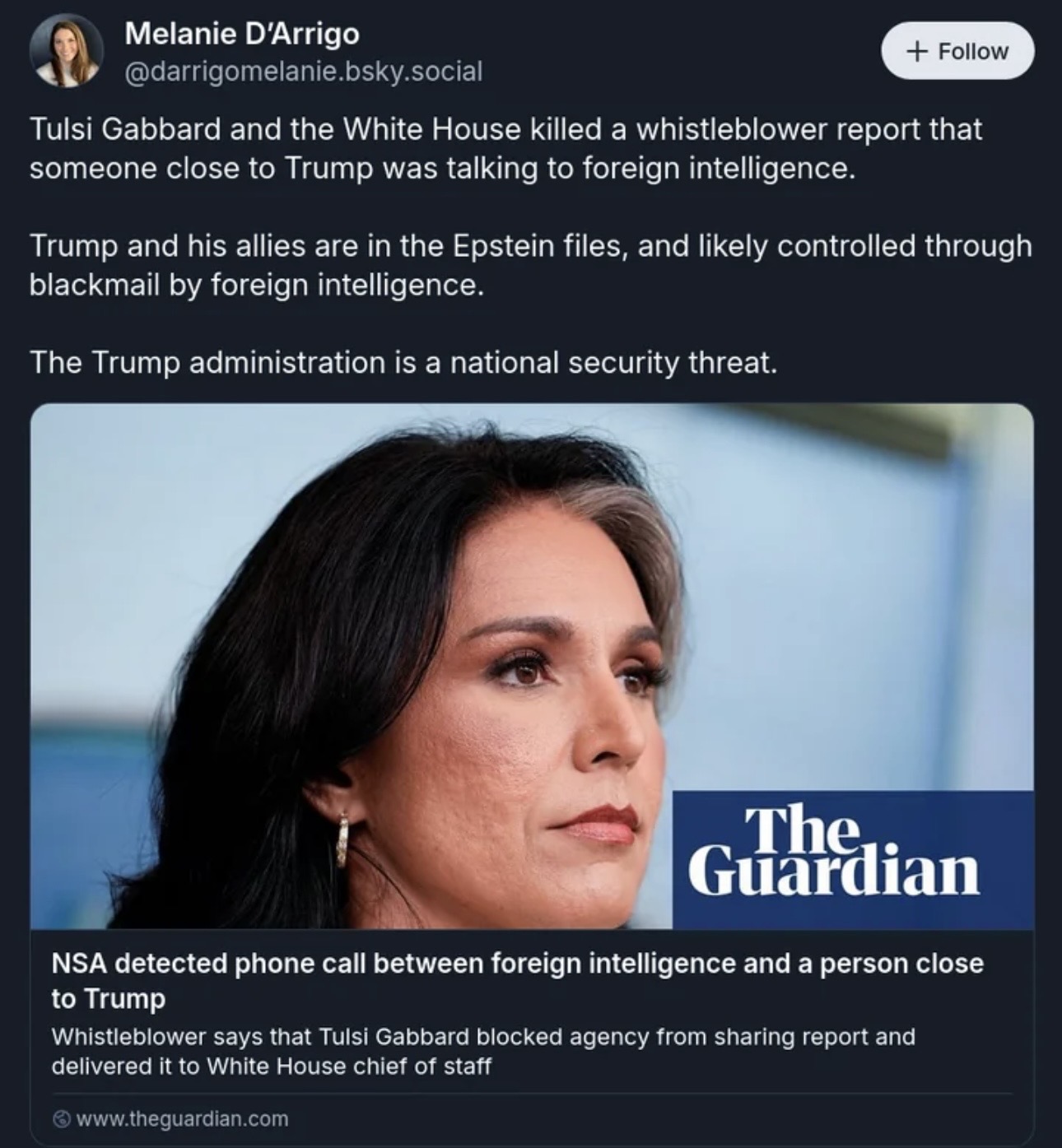
The controversy surrounding a whistleblower complaint against Director of National Intelligence (DNI) Tulsi Gabbard has escalated into a major political and national security debate. At its core are allegations that Gabbard blocked the dissemination of sensitive intelligence about a call between a person close to former President Donald Trump and a foreign intelligence actor, and then improperly delayed the complaint about this action from reaching Congress for eight months.

🔍 The Core Allegations
The complaint centers on an incident from the spring of 2025. According to the whistleblower’s attorney, Andrew P. Bakaj, the U.S. National Security Agency (NSA) detected an unusual phone call. The call was between a person described as “close to” or “associated with” former President Donald Trump and an individual linked to a foreign intelligence service.
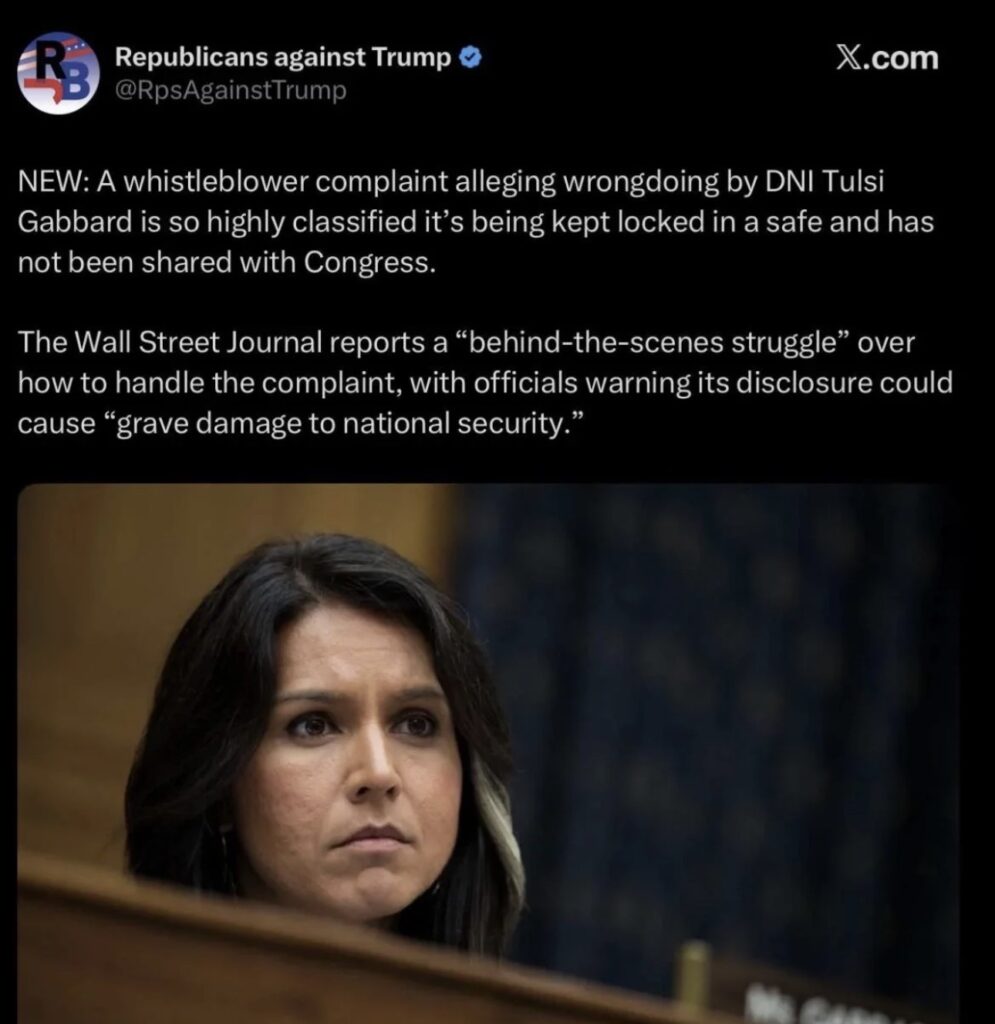
Although the precise nation-state involved is not officially confirmed, multiple reports state the intercepted conversation referenced Iran. Foreign policy experts note that such intercepts can be difficult to assess, as foreign officials sometimes make deliberately misleading statements knowing their communications may be monitored.
The whistleblower’s central allegation is that after this intercept was collected, DNI Gabbard took the report to White House Chief of Staff Susie Wiles. Following this meeting, Gabbard allegedly instructed the NSA not to distribute its intelligence report through normal channels but instead to send the highly classified details directly to her office. The complaint accuses Gabbard of restricting the sharing of this intelligence “for political purposes”.
⏳ A Contested Timeline: Key Dates
The handling of the complaint itself has become a major point of contention. Here are the key dates from the available reports:
· Spring 2025: NSA reportedly detects the call in question.
· April 17, 2025: Whistleblower first contacts the Intelligence Community Inspector General (IC IG) office.
· May 21, 2025: Formal whistleblower complaint is filed.
· June 2025: Then-IC IG Tamara Johnson dismisses the complaint, stating she “could not determine if the allegations appear credible”.
· June 6, 2025: An OIG letter indicates Gabbard was provided with the full complaint after Johnson’s determination.
· November 21, 2025: Attorney Andrew Bakaj sends a letter to Gabbard asking how his client should approach Congress with the complaint.
· December 4, 2025: Gabbard states she was informed by the current IC IG, Christopher Fox, of the need to provide security guidance to share the complaint with Congress.
· February 2026: Complaint is finally delivered to the congressional “Gang of Eight” (congressional leaders and intelligence committee heads).
🛡️ The Intelligence Community’s Response
The official response from Gabbard and the Office of the Director of National Intelligence (ODNI) has been one of strong denial and counter-accusation.
Gabbard and ODNI’s Defense:
· Gabbard states she has “never been in possession or control of the Whistleblower’s complaint” and therefore could not have hidden it.
· She asserts the complaint contains “baseless allegations” and was kept secured in a safe by the Inspector General, which is standard procedure for highly classified material.
· Her office claims every action was “fully within her legal and statutory authority”.
· The ODNI spokesperson blamed “self-serving actors” for “leaking lies and half-truths”.
Key Legal Argument:
Gabbard makes a crucial legal distinction: she argues the legal requirement to transmit a complaint to Congress within 21 days only applies when the Inspector General determines it to be both an “urgent concern” and “apparently credible.” Since the former IC IG, Tamara Johnson, did not find it credible, Gabbard contends no such timeline was triggered.
🏛️ The Partisan Divide in Congress
Reactions in Congress have split sharply along party lines.
Republican Support:
· Senator Tom Cotton (R-Ark.), Chairman of the Senate Intelligence Committee, reviewed the complaint and stated he agrees with the inspectors general that it “is not credible.” He called it “another effort by the president’s critics… to undermine policies that they don’t like”.
· Representative Rick Crawford (R-Ark.), House Intelligence Committee Chair, concurred, calling the ensuing media attention an “attempt to smear” Gabbard and the Trump administration.
Democratic Criticism:
· Senator Mark Warner (D-Va.), Vice Chairman of the Senate Intelligence Committee, has been the most vocal critic. He insists “the law is clear” that such complaints must be relayed to Congress within 21 days. Warner has questioned Gabbard’s competence, suggesting the delay shows she is “either not competent to do the job, or… didn’t have competent legal advice”.
· Representative Jim Himes (D-Conn.), ranking Democrat on the House Intelligence Committee, said he plans to “pull some threads” to learn more, rejecting the Republican conclusion that there is “absolutely nothing to see here”.
🗳️ Broader Context: Election Probes and Position
This controversy does not exist in isolation. Gabbard has recently drawn additional scrutiny for her unusual, on-site presence during FBI election-related searches in Georgia and Puerto Rico. Senator Warner has explicitly linked these actions, suggesting a “coordinated effort to try to interfere in the ’26 midterm”.

These simultaneous controversies have placed Gabbard in a precarious position:
· She appears to retain the confidence of the Trump administration and Republican congressional leaders.
· However, she faces intense, sustained criticism from Democratic lawmakers and questions about her adherence to nonpartisan intelligence norms.
· Her involvement in domestic election matters, which falls far outside the traditional foreign-focused remit of the DNI, has raised constitutional questions among experts.
🔮 What Comes Next?
The immediate legal confrontation continues. Attorney Andrew Bakaj stated that if Gabbard did not provide the promised security guidance by February 7, he would share an unclassified briefing with the House and Senate intelligence committees on February 9.
The long-term implications are significant:
- For Gabbard: Her credibility as an nonpartisan intelligence chief is under sustained attack. While she may be secure in her job as long as Trump supports her, her reputation in the intelligence community and with Congress is damaged.
- For the Whistleblower: Their attorney continues to push for full disclosure to Congress, arguing that national security implications demand proper oversight.
- For Intelligence Oversight: This case tests the strength of congressional oversight mechanisms when the executive branch controls the intelligence apparatus and disputes the credibility of internal critics.
The controversy encapsulates the ongoing tension in U.S. intelligence between operational secrecy, legal compliance, and political accountability. With an election approaching and Gabbard deeply involved in reviewing past election claims, these tensions are likely to intensify rather than fade.