

DAVOS, Switzerland — In a stark address to the World Economic Forum, Canadian Prime Minister Mark Carney declared the era of predictable global rules over, warning that “the strong do what they can, and the weak suffer what they must.” While never naming the United States, his speech was a direct challenge to the “dangerous departures” and bullying tactics that have defined Donald Trump’s second term.
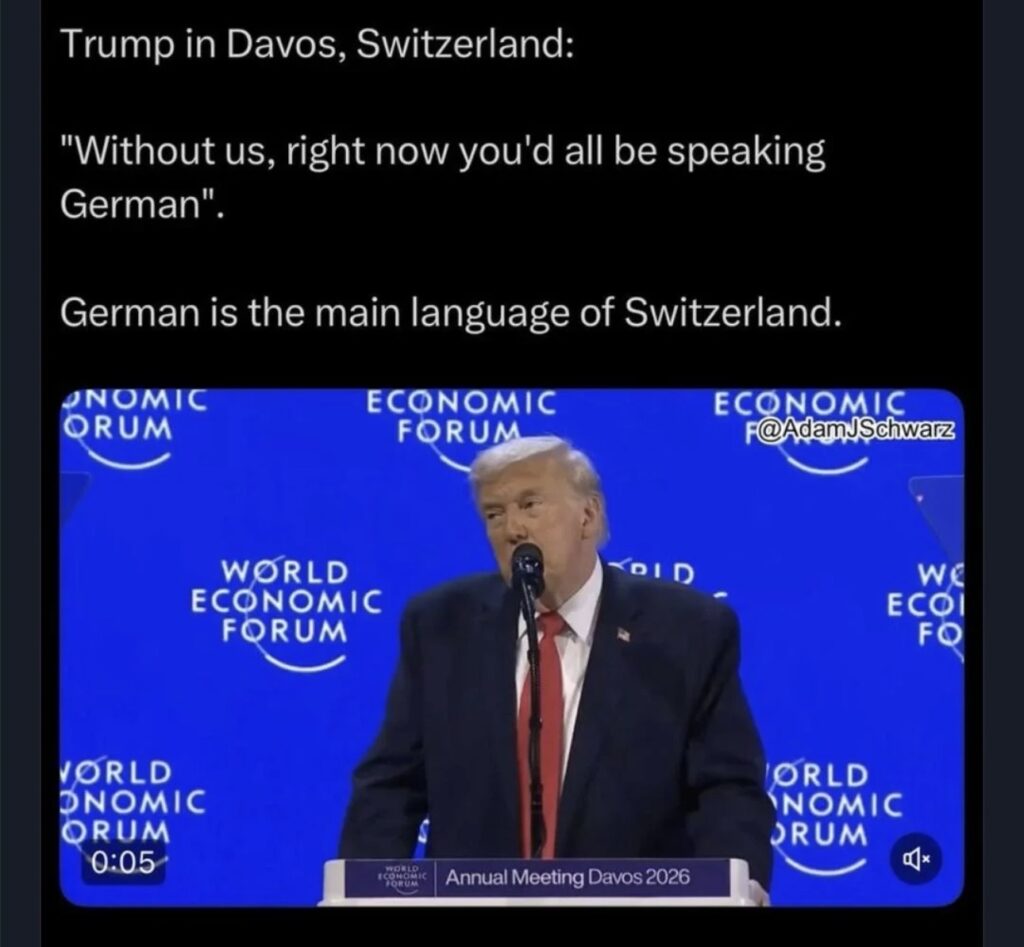
The speech, delivered on January 20, 2026, and met with a standing ovation, marked a radical shift for Canada—from a neighbor seeking accommodation to a “principled and pragmatic” middle power ready to lead a coalition of nations unwilling to submit to coercion.
The End of “Living Within a Lie”
Carney framed the current global climate as a “rupture, not a transition.” He argued that for decades, countries like Canada prospered under a U.S.-led order, willingly ignoring its hypocrisies—where rules were applied unevenly and the powerful exempted themselves. This was “living within a lie,” a performance of compliance that no longer guarantees safety.

“The bargain no longer works,” Carney stated. He detailed how great powers now weaponize the very systems of integration—using “tariffs as leverage, financial infrastructure as coercion, supply chains as vulnerabilities to be exploited”. This thinly veiled critique of Trump’s policies painted a picture of an America that has abandoned the pretense of rules for the “unhindered pursuit of power and interests”.
A “Thinly Veiled Reference” to American Threats
Analysts and diplomats immediately understood the target. “Leaders in other western capitals have alluded to ‘dangerous departures’ Trump has taken from norms,” said international relations professor Jack Cunningham, “but they always return to the possibility that he can be appeased… Mr. Carney has exposed that as simply inaccurate”.

The speech’s timing was deliberate, coming amid a series of aggressive U.S. actions:
· Greenland: Trump has repeatedly threatened to impose levies on European nations opposing his bid to “seize control” of the autonomous Danish territory.
· Canada: The U.S. president has made repeated threats to annex parts of Canada, turning a neighbor and NATO ally into a target of expansionist rhetoric.
· Unreliable Alliance: Carney’s doctrine stems from a core realization: “The prime minister knows that Trump’s commitment and his words are essentially worthless. He can—and often does, go back on them on a whim”.
Trump’s “Gangster” Response
The rebuke did not go unanswered. The next day, Trump delivered a rambling address where he confused Greenland with Iceland and singled out Carney by name. “Canada lives because of the United States,” Trump declared. “Remember that, Mark, next time you make your statements”.
To many, this was the perfect, ugly proof of Carney’s thesis. The comment revealed “the naked threat of power by the American president to coerce its neighbour and ostensible ally,” wrote The Conversation, calling it a “‘gangster’ mindset… effectively saying: ‘Nice country, Mark. Be a shame if something happened to it'”.
The Middle-Power Doctrine: “If You Are Not at the Table, You Are on the Menu”
Faced with this reality, Carney argued that middle powers cannot afford nostalgia or isolation. Their path forward is “variable geometry”—forming flexible, values-based coalitions for different issues, from supporting Ukraine and Greenland’s sovereignty to forging new trade links in Asia and Europe.

“The question for middle powers… is not whether to adapt to this new reality. We must,” Carney said. “The question is whether we adapt by simply building higher walls—or whether we can do something more ambitious”. His answer was unequivocal: “Middle powers must act together because if you are not at the table, you are on the menu”.
A Line in the Sand
Carney’s Davos speech is more than a critique; it is a blueprint for resistance. By openly acknowledging the failure of appeasement and calling for collective action, he has drawn a line for other nations uneasy with Trump’s transactional bullying. The challenge now is whether this coalition of the willing can muster the resolve to back rhetoric with action, or if the world will succumb to a new age where might alone makes right. As Carney concluded, “the power of legitimacy, integrity, and rules will remain strong – if we choose to wield it together”.